

Resume Problems That Stop You Getting Hired
 RoastGPT Team
The resume problems that stop you getting hired: ATS blocks, no impact, wrong fit, weak summary, and more. Learn what stands between you and an offer, and how to fix it with a resume roast.
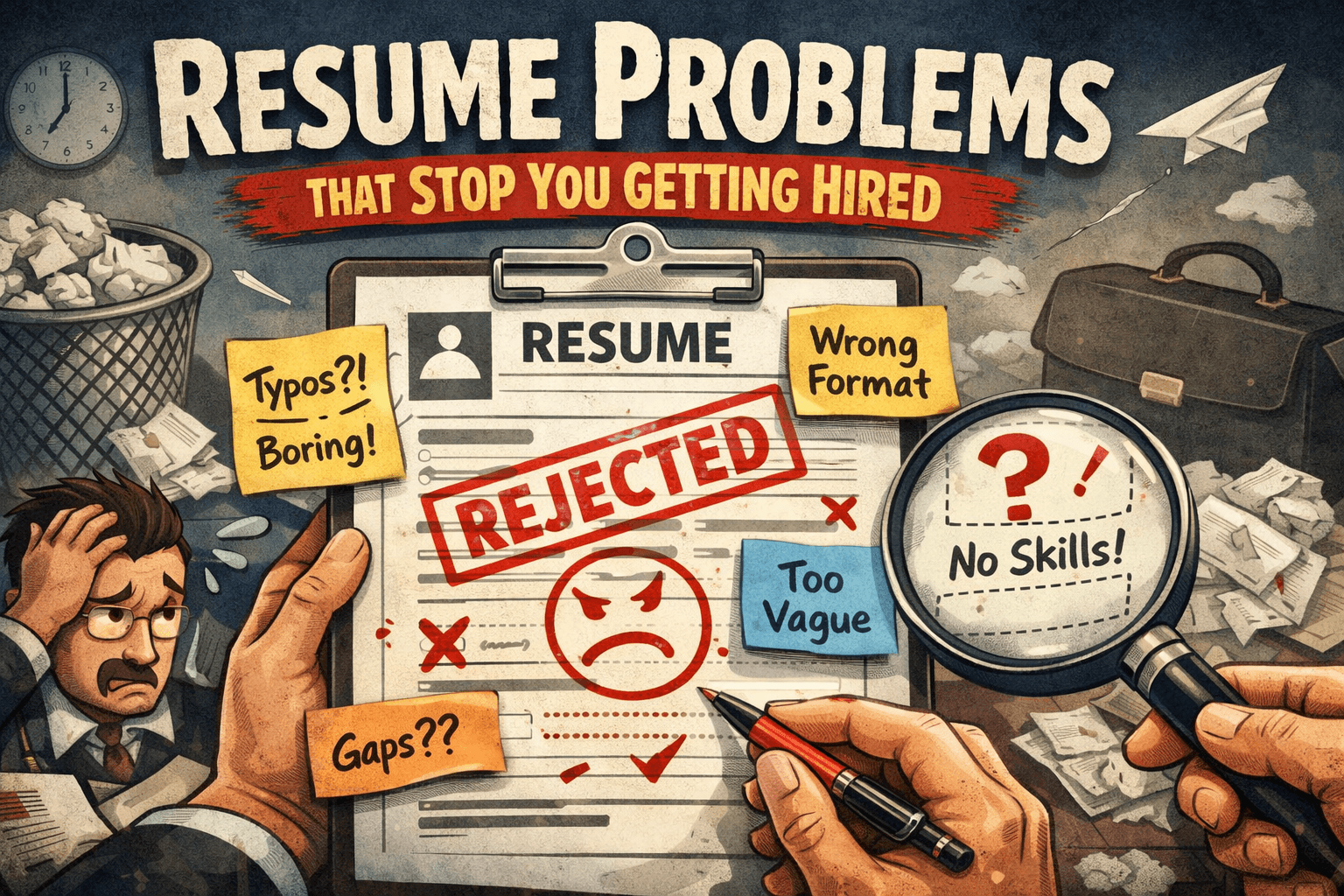
Getting hired depends on a chain of steps: your resume gets parsed, a recruiter sees it, they like what they see, and you move to the next stage. Resume problems are what break that chain. They’re the things that stop you from getting hired, not because you’re unqualified, but because your resume never gets a fair read, never passes the scan, or never gives a hiring manager a reason to say yes. This article breaks down the main resume problems that stop you getting hired and how to fix them so the chain holds.
We’ve run thousands of resume roasts on RoastGPT’s Roast My Resume. The issues that show up most often are the same ones that stop people from getting hired: format failures, weak positioning, no impact, and poor fit. Fix these problems first.
1. Your Resume Never Reaches a Human (ATS Problem)
The problem: Your resume is filtered out by an Applicant Tracking System before a recruiter ever opens it. Tables, text boxes, multiple columns, image-only PDFs, or non-standard headers make your file unparseable. The ATS can’t read your experience or skills, so you’re marked unqualified or never ranked. You’re not being “rejected”, you’re never in the running.
Why it stops you getting hired: The hiring process never starts. No human sees you. No amount of great content matters if the system blocks you at the gate.
Fix: Use a simple, single-column layout. Standard section headers (Experience, Education, Skills). No tables or graphics. Save as PDF or .docx with selectable text. Roast your resume with the AI Recruiter persona to see how ATS-friendly your resume is and what’s blocking you.
2. You Fail the 6–10 Second Scan (Scannability Problem)
The problem: Recruiters spend a few seconds on a first pass. They look for: current role, key skills, summary. If your resume is dense, unclear, or hard to navigate, they don’t read further. You fail the scan test before they ever decide whether you’re a fit.
Why it stops you getting hired: You never get a real read. Failing the scan means nothing else on your resume gets a chance to work.
Fix: Clear section headers, reverse chronological order, readable font and spacing, one or two pages. Make the basics obvious in under 10 seconds. Roast your resume with the Tech Recruiter or Corporate HR persona to flag format and scannability issues.
3. Your Summary Doesn’t Tell Them Who You Are (Positioning Problem)
The problem: Your summary is generic (“Hardworking professional seeking a challenging role”) or missing. The top of your resume has one job: answer Who is this? What do they do? What do they want? in 2–3 lines. If you don’t, recruiters have no hook and no reason to keep reading.
Why it stops you getting hired: No clear identity. They can’t tell your level, focus, or whether you’re targeting this kind of role. Generic = skipped.
Fix: Write a tight summary: role level + one or two concrete strengths + (optional) target. “Senior product manager with 8 years in B2B SaaS. Scaled two products from launch to $10M ARR. Seeking a Head of Product role at a growth-stage company.” The Career Coach and Professional Resume Writer personas on Roast My Resume are built to tear apart weak or missing summaries.
4. Your Bullets Don’t Show Impact (Replaceability Problem)
The problem: Your experience section reads like a job description: what you were responsible for, not what changed because of you. “Managed the team.” “Handled customer inquiries.” “Supported various projects.” That could be anyone. Recruiters and hiring managers are looking for outcomes and results. Task lists get skimmed; impact gets attention.
Why it stops you getting hired: You sound replaceable. You don’t give them a reason to pick you over the next resume in the pile.
Fix: Use Action + Result + (optional) Metric. “Launched referral program that increased signups 25% in Q3.” “Reduced support ticket volume 40% by improving help center and routing.” Roast your resume with the Tech Recruiter or Product Manager persona to get specific feedback on turning duties into impact.
5. You Don’t Match the Job (Fit Problem)
The problem: Your resume doesn’t reflect the skills, level, or language of the job posting. Keywords are missing or buried. Your title and experience don’t align with what they’re hiring for. The ATS ranks you low, or a recruiter’s quick “does this match?” check ends in a pass.
Why it stops you getting hired: No clear match. They’re not going to connect the dots for you. Fit has to be obvious.
Fix: Mirror the job description’s language where it honestly applies. Weave keywords into your summary and bullets. Don’t copy-paste; show fit with proof. The keyword match and role fit analysis in a resume roast report shows where you’re aligned and where you’re missing the mark.
6. Your Skills Section Doesn’t Prove Anything (Credibility Problem)
The problem: A long list of technologies or soft skills with no context. “Python, Java, AWS, Leadership, Communication.” Recruiters can’t tell if you used Python for a weekend project or shipped production systems. The Tech Recruiter persona on RoastGPT roasts this: “Your stack sounds impressive until I realize you just listed buzzwords without impact.” Skills without proof don’t help, they make you look like you’re padding.
Why it stops you getting hired: You don’t stand out. Everyone lists skills. Without context, yours don’t build credibility.
Fix: Tie skills to experience. Show where and how you used them. “Python: Built data pipelines processing 1M+ records/day.” Roast your resume to see if your skills section is earning its place or holding you back.
7. Errors and Inconsistencies (Trust Problem)
The problem: Typos, wrong dates, inconsistent formatting, grammar mistakes. They signal that you didn’t care enough to proofread. For roles that require attention to detail (which is most of them), that’s a fast reason to pass. One or two errors can be enough to bin you.
Why it stops you getting hired: Carelessness kills trust. Once trust is damaged, they’re not going to take a bet on you.
Fix: Read your resume backward. Use a spell-checker. Have someone else read it. Roast your resume; our AI catches grammar and consistency issues that spell-check misses so you can fix them before a recruiter does.
8. Your Career Story Doesn’t Make Sense (Narrative Problem)
The problem: Jobs listed with no thread connecting them. Unexplained gaps or pivots. The Career Coach persona says it: “Your career story should make sense. Right now it reads like random side quests.” Hiring managers want to understand your trajectory. Chaos reads as unfocused, and unfocused candidates get passed over.
Why it stops you getting hired: They can’t tell if you’re a fit for this role or just spraying applications. No story = no trust.
Fix: Use your summary to frame the story. Address gaps briefly. Make the reader see a logical path. Roast your resume with the Career Coach to see if your career story holds together.
9. Wrong Length (Prioritization Problem)
The problem: A 3-page resume for someone with 3 years of experience, recruiters won’t read it. Or a half-page with almost no detail, they can’t evaluate you. Wrong length signals either that you can’t prioritize (too long) or that you’re not serious (too short).
Why it stops you getting hired: Too long = easy to skip. Too short = easy to dismiss. Both get you filtered out.
Fix: Early career: 1 page. Mid-career: 1–2 pages. Senior/exec: 2 pages max. Every line should earn its place. A resume roast gives you section-by-section feedback so you know what to trim and what to strengthen.
10. No Numbers or Scale (Credibility Problem)
The problem: “Improved processes.” “Increased efficiency.” “Grew the business.” No numbers, no scale, no before/after. Numbers create credibility. “Improved” could mean 2% or 200%. Hiring managers in finance, product, and growth roles want to see scale and impact. Without it, you sound vague.
Why it stops you getting hired: No proof. You’re asking them to believe you without evidence. In a stack of resumes, that’s not enough.
Fix: Add numbers wherever you can: percentages, dollar amounts, team size, time saved, users reached. “Reduced support tickets 25%.” “Managed $2M budget.” “Led team of 8.” Roast your resume with the Finance Hiring Manager or Product Manager to get feedback on your quantification.
11. Buzzwords and Filler (Differentiation Problem)
The problem: “Leveraged synergies to drive scalable solutions.” “Results-driven team player with excellent communication skills.” The Office Gossip Queen persona on RoastGPT: “Oh you ‘spearheaded strategic initiatives’? Babe… you updated a spreadsheet.” Buzzwords and filler say nothing. Recruiters have seen it a thousand times and move on.
Why it stops you getting hired: You’re invisible. Your resume doesn’t differentiate you; it makes you look like everyone else hiding behind jargon.
Fix: Replace every buzzword with a concrete example. Delete “team player” and “detail-oriented” unless you back them up with proof. Roast your resume with the Office Gossip Queen or Tech Recruiter to find where you’re hiding behind vague language.
12. Exaggeration or Inconsistency (Trust Problem)
The problem: “Expert” in a skill you used once. “Led” a project when you were one of five contributors. Inflated titles or responsibilities that don’t match the rest of the resume. Experienced recruiters spot exaggeration quickly. One caught exaggeration can undermine your whole application.
Why it stops you getting hired: Trust destroyed. Once they doubt one claim, they doubt the rest.
Fix: Be accurate. “Contributed to” is fine when that’s what you did. “Proficient” beats “Expert” if you’re not ready to prove it in an interview. Roast your resume with the Tech Recruiter or Corporate HR to see if any of your claims read as overstated.
Summary: Problems That Stop You Getting Hired
| Problem | Why it stops you |
|---|---|
| ATS blocks you | You never reach a human |
| Fail the scan | You never get a real read |
| Weak or no summary | No hook; no identity |
| No impact in bullets | You sound replaceable |
| Poor job fit | No clear match |
| Skills without proof | No credibility |
| Errors / inconsistencies | Trust destroyed |
| Career story doesn’t hold | You look unfocused |
| Wrong length | Skipped or dismissed |
| No numbers | No proof |
| Buzzwords / filler | You’re invisible |
| Exaggeration | Trust destroyed |
None of these are unfixable. The first step is seeing them clearly. That’s what a resume roast is for: no sugar-coating, just scores and section-level feedback so you know which problems are stopping you from getting hired and how to fix them.
What to Do Next: Fix the Problems That Stop You
Getting hired means your resume has to pass every step: parse, scan, summary, impact, fit, and trust. Fix the problems that break that chain.
- Run a roast. Go to Roast My Resume, upload your resume, and pick a persona (Tech Recruiter or AI Recruiter for a first pass) and your industry.
- Fix the blockers. Use the report to tackle ATS format, summary, impact bullets, fit, skills in context, length, and narrative.
- Roast again. After edits, run another roast with a different persona (e.g. Corporate HR for polish, Career Coach for story) to stress-test.
The same problems we see in thousands of roasts are the same ones that stop most people from getting hired. Spot them, fix them, and use RoastGPT to keep your resume in the game.