

Why Recruiters Ignore Your Resume
 RoastGPT Team
The real reasons recruiters skip or ignore your resume: scan failure, ATS filters, no impact, poor fit, and red flags. Learn why you're getting passed over and how to fix it with a resume roast.
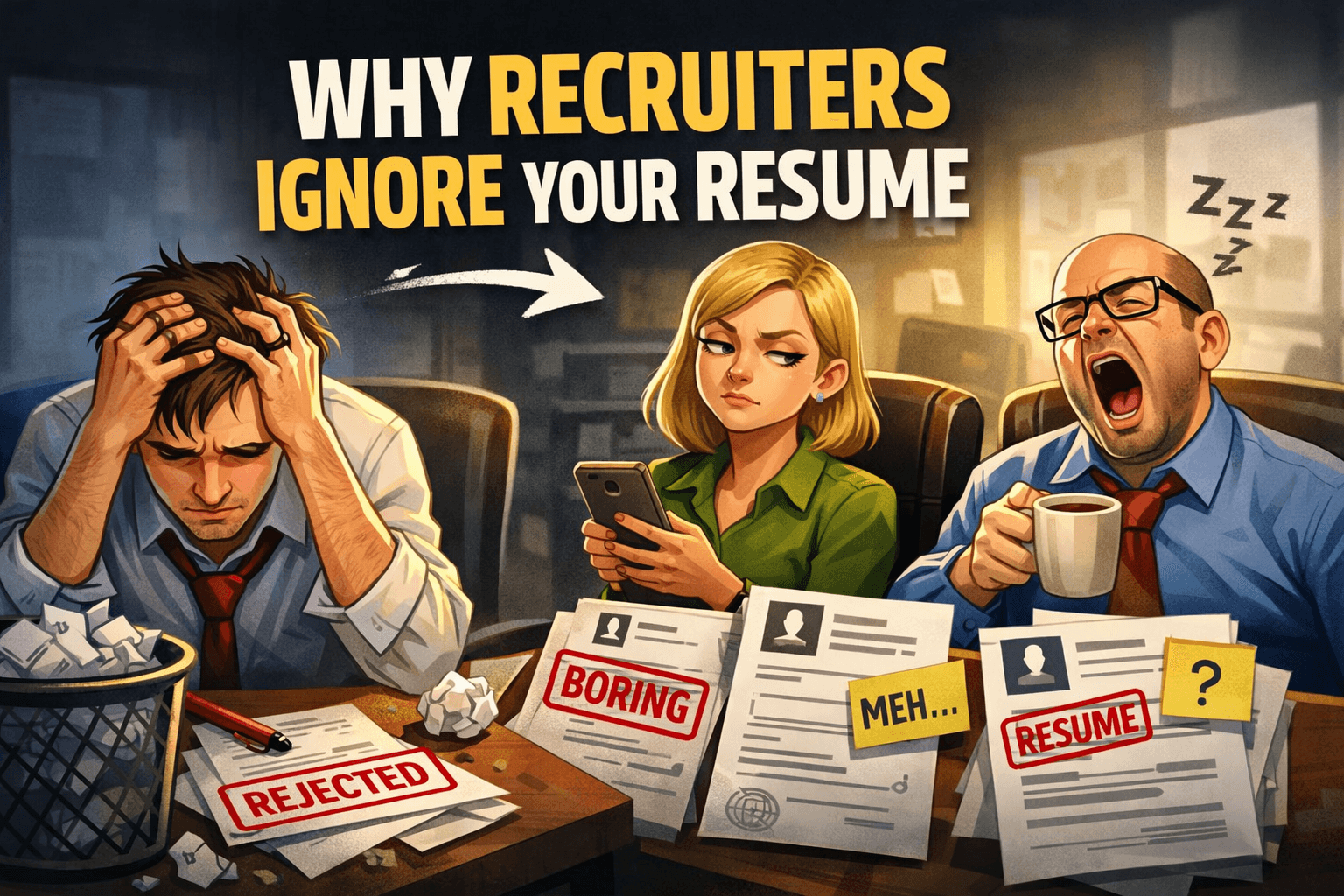
You've applied to dozens of roles. You're qualified. So why aren't recruiters responding? In most cases, they're not deciding against you, they're ignoring you. Something in your resume triggers a skip before they ever give you a real read. This article breaks down the main reasons recruiters ignore resumes and how to fix each one so you stop getting passed over.
They're Not Reading, They're Scanning
Recruiters often spend 6–10 seconds on a first pass. In that window they're asking: Can I find the basics? Is this relevant? Does it look professional? If the answer to any of those is no, they move on. They're not being unfair; they're filtering hundreds of applications with limited time.
Why they ignore you: Your resume fails the scan test. Dense paragraphs, unclear sections, tiny font, or a layout that makes the eye work too hard. They can't find your current role, your skills, or your summary in a few seconds so they assume it's not worth a closer look.
Fix: Make your resume scannable. Clear section headers (Experience, Education, Skills), reverse chronological order, readable font and spacing, and one or two pages max. A resume roast with the Tech Recruiter or Corporate HR persona will flag format and scannability so you can fix them first.
The ATS Filtered You Out Before a Human Saw It
Before a recruiter opens your resume, it often goes through an Applicant Tracking System (ATS). The ATS parses your file, matches keywords, and scores or filters you. If the system can't read your resume (tables, columns, image-only PDF) or you're missing key terms from the job, you're never shown to a human. Recruiters aren't ignoring you, they never see you.
Why they "ignore" you: You didn't pass the gate. Parsing failed, so your experience or skills are missing or jumbled in the ATS view. Or your keyword match was too low, so you're ranked at the bottom or filtered out entirely.
Fix: Use a simple, single-column layout with standard section names. Save as PDF or .docx with selectable text (no image-only PDFs). Mirror important keywords from the job description in your summary and bullets. Roast your resume with the AI Recruiter persona to see how ATS-friendly your resume is and what's blocking you.
Your Summary Doesn't Answer "Who Is This?"
The top of your resume has one job: answer Who is this person? What do they do? What do they want? in 2–3 lines. If your summary is generic ("Hardworking professional seeking a challenging role") or missing, recruiters have no hook. They're not going to dig through your experience to figure it out.
Why they ignore you: No clear identity. They can't tell your level, your focus, or whether you're even targeting the kind of role they're hiring for. Generic = forgettable.
Fix: Write a tight summary: role level + one or two concrete strengths + (optional) target. "Senior product manager with 8 years in B2B SaaS. Scaled two products from launch to $10M ARR. Seeking a Head of Product role at a growth-stage company." The Career Coach and Professional Resume Writer personas on Roast My Resume are built to evaluate your summary, use them to fix a weak or missing one.
Your Bullets Describe Tasks, Not Impact
Recruiters don't ignore you because you're unqualified. They ignore you because your experience section reads like a job description: what you were responsible for, not what changed because of you. "Managed the team." "Handled customer inquiries." "Supported various projects." That could be anyone. It doesn't give them a reason to care.
Why they ignore you: No proof of impact. They're looking for outcomes, scale, and results. Task lists get skimmed and skipped. Impact gets attention.
Fix: Use Action + Result + (optional) Metric. "Launched referral program that increased signups 25% in Q3." "Reduced support ticket volume 40% by improving help center and routing." Roast your resume with the Tech Recruiter, Product Manager, or Finance Hiring Manager persona to get specific feedback on turning duties into impact.
You Don't Match the Job (Keywords and Fit)
Recruiters and ATS both use keywords and role fit to screen. If your resume doesn't reflect the skills, level, or industry in the job posting, you're ranked low or filtered out. Even if a human sees you, a quick scan for "does this match what we need?" can end in a pass.
Why they ignore you: No clear match. Your skills are buried, your title doesn't align, or your experience feels irrelevant. They're not going to connect the dots for you.
Fix: Mirror the job description's language where it honestly applies. Use the same tools, certifications, and level language. Don't stuff keywords, weave them into your summary and bullets. The keyword match and role fit analysis in a resume roast report shows where you're aligned and where you're missing the mark.
Your Skills Section Is a List With No Proof
A skills section that's just "Python, Java, AWS, Leadership, Communication" doesn't tell recruiters how or where you used those skills. They can't tell if you're expert or beginner, or if it's relevant to the role. So they skim it and move on or assume it's padding.
Why they ignore you: Skills without context don't differentiate you. Everyone claims "communication" and "leadership." Recruiters look for skills backed by experience and results.
Fix: Tie skills to outcomes in your experience. "Python: Built data pipelines processing 1M+ records/day." Or group by proficiency and keep the list focused. The Tech Recruiter persona on RoastGPT is built to roast "buzzwords without impact", roast your resume to see if your skills section is earning its place.
Errors and Inconsistencies Signal Carelessness
Typos, wrong dates, inconsistent formatting, and grammar mistakes don't just look bad, they signal that you didn't care enough to proofread. For roles that require attention to detail (which is most of them), that's a fast reason to pass.
Why they ignore you: One or two errors can be enough. "Detail-orientated," "Recieved," mixed date formats, or a messy layout suggest you'll be sloppy in the job too.
Fix: Proofread line by line. Use a spell-checker. Have someone else read it. A resume roast also catches consistency and polish issues that spell-check misses, so you can fix them before a recruiter does a close read.
Your Career Story Doesn't Make Sense
Recruiters like to see a logical trajectory. If your resume jumps between unrelated fields with no explanation, or has big gaps with no context, they wonder if you're unfocused or hiding something. They're not going to spend time decoding it.
Why they ignore you: Chaotic or random-looking career path. They can't tell if you're a fit for this role or just spraying applications.
Fix: Put the most relevant experience first. Explain gaps or pivots briefly (e.g. in your summary or next to the role). Make sure your summary and experience point in the same direction. The Career Coach persona on Roast My Resume evaluates whether your career story holds together and tells you how to fix it if it doesn't.
You're Saying Nothing (Generic Copy)
Resumes that could belong to anyone get treated like they belong to no one. "Results-driven professional with excellent communication skills." "Seeking a challenging role in a dynamic environment." That's filler. Recruiters have seen it a thousand times. They don't ignore you because you're bad, they ignore you because you're invisible.
Why they ignore you: No differentiation. Your resume doesn't say anything specific about you, your impact, or your fit for this job.
Fix: Replace every generic phrase with something concrete. Role, industry, scale, outcomes, tools. The Office Gossip Queen persona on RoastGPT exists to call out buzzword inflation. Roast your resume to find where you're hiding behind vague language and get suggestions that actually say something.
You're Overloading or Under-delivering
Too much: a five-page resume with every job since high school. Recruiters won't read it. Too little: a half-page with almost no detail. They can't evaluate you. Either way, you're easy to skip.
Why they ignore you: Wrong length and density. They need enough to judge you, but not so much that they give up before the first page.
Fix: One page for early career, one to two for mid/senior and every line should earn its place. Cut irrelevant or old roles; add impact and context where it matters. A resume roast gives you section-by-section feedback so you know what to trim and what to strengthen.
What to Do Next: Stop Getting Ignored
Recruiters ignore resumes for consistent reasons: scan failure, ATS filters, no clear summary, no impact, poor fit, weak skills section, errors, a broken career story, generic copy, or wrong length. You can't control how many applications they get but you can control whether your resume gives them a reason to stop ignoring you.
- Run a roast. Go to Roast My Resume, upload your resume, and pick a persona (Tech Recruiter or Corporate HR for a first pass) and your industry.
- Fix the reasons they ignore. Use the report to address format, ATS issues, summary, impact bullets, keywords, skills in context, consistency, and career story.
- Roast again. After edits, run another roast with a different persona (e.g. AI Recruiter for ATS, or your industry's hiring manager) to stress-test.
Once you know why recruiters ignore your resume, you can fix it. Roast My Resume gives you that feedback in minutes so you can stop getting passed over and start getting callbacks.