
Why Your Startup Landing Page Isn't Working
 RoastGPT Team
Startup landing pages fail for specific reasons: unclear audience, weak social proof, feature-heavy copy, and onboarding friction. Here's how to fix yours and get more early adopters with help from a landing page roast.
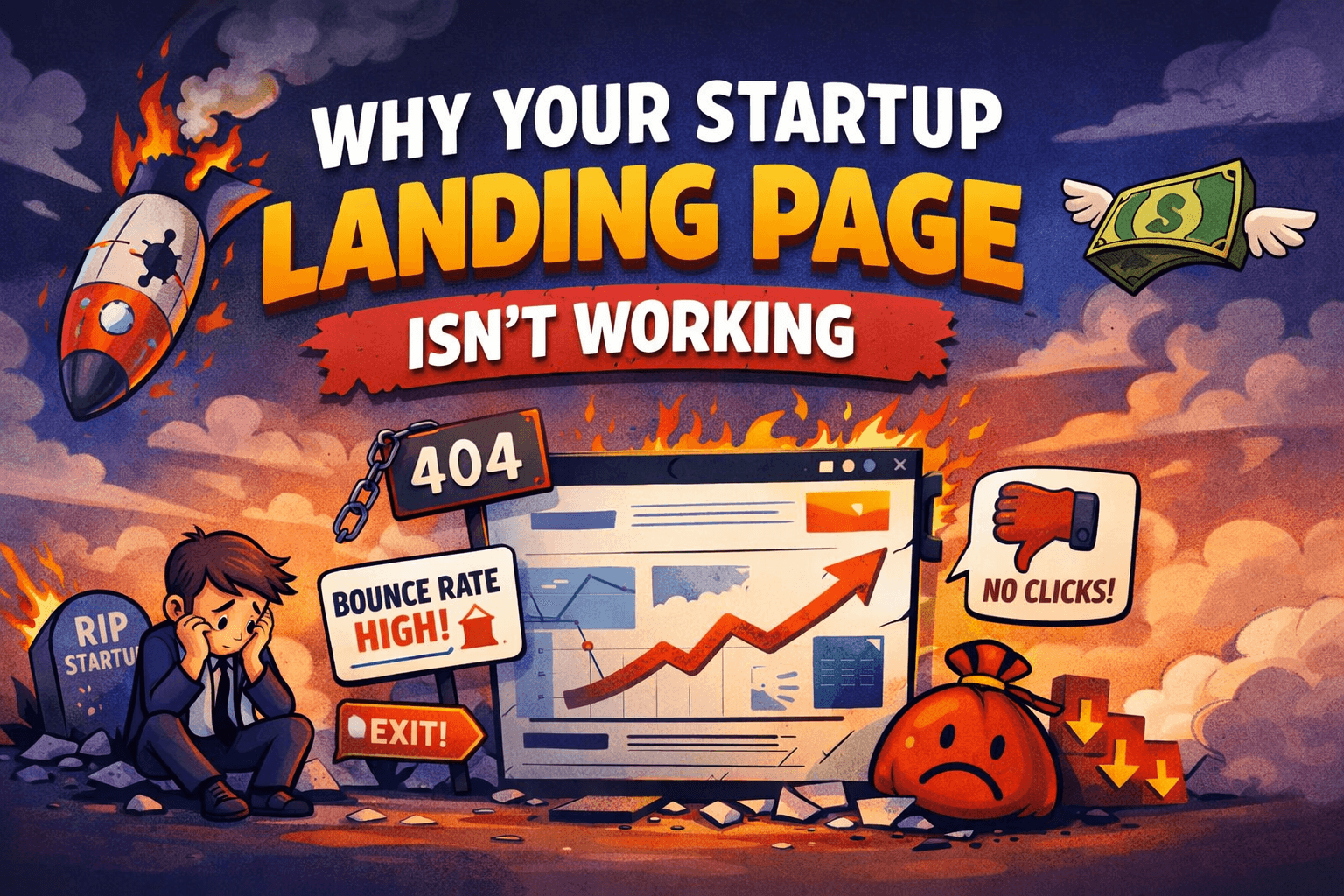
You’ve built something you believe in. You’ve got a landing page. But signups, waitlist adds, or demo requests? They’re trickling in or not at all. The problem usually isn’t the product. It’s that startup landing pages fail in a few predictable ways: unclear who they’re for, weak or missing social proof, copy that dumps features instead of outcomes, and friction that makes “try it” feel risky or complicated. This article walks through why your startup landing page isn’t working and how to fix it including using a landing page roast to get honest, persona-based feedback fast.
Startups Face a Different Game
Big companies can get away with vague messaging because they have brand recognition. Startups don’t. You have one page, a few seconds of attention, and no reputation to fall back on. So your landing page has to do more with less: instant clarity, obvious benefit, and enough trust to get that first signup or click. When we roast startup landing pages on RoastGPT, we see the same gaps over and over. Here’s what’s going wrong and what to do instead.
1. You’re Not Saying Who It’s For
What’s wrong: The page talks about the product in the abstract. “The all-in-one platform for teams.” “AI-powered workflow automation.” Visitors can’t tell if they’re in the right place. Are you for developers? Founders? Marketing teams? Enterprises or solopreneurs? If you’re trying to speak to everyone, you end up persuading no one.
Why it hurts startups: Early adopters are looking for a tribe. They want to feel “this is for people like me.” Generic positioning makes them bounce before they ever see the value.
Fix: Name your primary audience in the hero or right below it. “Built for early-stage founders who…” or “For product teams that…” One clear sentence. Then roast your landing page with the Marketing Guru or Confused Customer persona, they’re built to call out fuzzy or absent audience definition.
2. You Have No Social Proof (or You’re Hiding It)
What’s wrong: “We’re pre-launch.” “We’re in beta.” So you skip testimonials, logos, and case studies. Or you bury the one or two good quotes you have somewhere near the footer. Visitors think: “No one’s using this yet. Why should I be the first?”
Why it hurts startups: You don’t have a brand yet. Trust has to come from proof: other people, results, or at least a clear “here’s what you get.” Without it, the CTA feels risky.
Fix: Use what you have. Beta testers, design partners, or early users, get one line from each. “Joined the waitlist and got access in 48 hours.” “Used the beta for two weeks, now we’re paying.” If you have logos (investors, accelerators, partners), show them. Put the strongest proof near the first CTA, not only in the footer. Then run a landing page roast with the Conversion Consultant or Brand Therapist to see if trust is still the weak spot.
3. Your Copy Is a Feature Dump, Not a Benefit Story
What’s wrong: Bullet points and paragraphs about “integrations,” “dashboard,” “API,” “real-time sync.” It reads like a spec sheet. Visitors don’t care about features until they understand the outcome: what changes for them, what problem goes away, what they get that they don’t have today.
Why it hurts startups: You’re close to the product. You think in features. But strangers need to see themselves in the story first: “I have this problem → this solves it → here’s what I get.”
Fix: For every feature, ask: “So that the user can…?” Lead with that. “Ship faster” instead of “CI/CD pipeline.” “Never miss a lead” instead of “Slack integration.” One clear outcome per section. The Copywriting Comedian persona on Roast My Landing Page is built to roast copy that talks a lot but doesn’t make people click, use it to find where you’re still in feature mode.
4. Your Hero Doesn’t Land in 3 Seconds
What’s wrong: The headline is vague (“Reimagine how teams work”) or full of jargon. The main benefit is in paragraph two or three. Or there’s no single, obvious CTA above the fold.
Why it hurts startups: You don’t have a second chance. If someone doesn’t get “what is this” and “why should I care” in a few seconds, they’re gone. No brand loyalty to fall back on.
Fix: One headline that states the outcome or core offer. One subline that adds who it’s for and what changes. One primary CTA. No buzzwords. If you’re not sure, roast your page and check what the Grumpy UX Designer or Confused Customer says about your hero, they’ll tell you exactly where the message gets fuzzy.
5. Onboarding or Signup Feels Heavy or Unclear
What’s wrong: Long forms, too many steps, or a signup flow that doesn’t set expectations (“What happens after I click?”). Or the CTA says “Get started” but the next screen feels like a commitment. No trial, no “see how it works first,” just a wall of fields.
Why it hurts startups: Early adopters are willing to try new things, but they’re also cautious. If the path from “interested” to “signed up” feels long, confusing, or risky, they drop off.
Fix: Shorten the first step. Ask only what you need (e.g. email + one qualifier). Add one line under the CTA: “No credit card. Set up in 2 minutes.” Use a Form Flow Inspector roast on Roast My Landing Page to get feedback on form length, clarity, and friction.
6. You Look Like Every Other Startup
What’s wrong: Same template, same “We’re building the future of X,” same stock photos, same gradient hero. Nothing that says “we’re different” or “we get you.”
Why it hurts startups: In a sea of similar pages, you blend in. Visitors don’t remember you. They don’t feel a reason to choose you over the next tab.
Fix: One differentiator in the hero or right after. Not a list of features, one clear “why us” or “why now.” Real photos or illustrations if you can. A tone of voice that matches your audience (e.g. technical, playful, no-nonsense). A landing page roast with the Brand Therapist or Unimpressed UI Designer can point out where you’re generic and where you could stand out.
7. Your CTA Is Weak, Buried, or Broken
What’s wrong: “Learn more.” “Submit.” Buttons that blend into the background. Or a primary CTA that’s below the fold, or worse, doesn’t work when clicked.
Why it hurts startups: You have one main action. If it’s invisible, vague, or broken, you get zero credit for the rest of the page.
Fix: One primary CTA per section. Action-oriented copy: “Join the waitlist,” “Start free trial,” “See a demo.” High contrast. Test every button. Run a roast with the Conversion Consultant on Roast My Landing Page. They’re built to call out weak or missing CTAs.
8. You’re Optimizing for the Wrong Stage
What’s wrong: The page is built for “everyone who might ever buy” instead of “people who can say yes today.” Or it’s written for investors instead of users. Or it’s so minimal (“Coming soon”) that there’s no reason to give an email.
Why it hurts startups: Early on, you need early adopters: people who get it, want in, and will give feedback. A page aimed at “the market” often misses them.
Fix: Be explicit about your stage. “We’re in private beta, join the waitlist for early access.” Or “Launching in Q2—reserve your spot.” Then make the next step obvious and low-friction. A landing page roast can surface whether your page speaks to “everyone” or to the people you actually want first.
What to Do Next
- Run a roast. Go to Roast My Landing Page, paste your startup landing page URL, and pick a persona. For a first pass, Grumpy UX Designer (flow and clarity) or Conversion Consultant (offers and CTAs) work well. For copy, add Copywriting Comedian or Marketing Guru.
- Fix the biggest gaps. Use the report to tackle audience clarity, hero, social proof, and CTA first. Then reduce friction in signup or onboarding.
- Roast again. After you’ve made changes, run another roast, maybe with Confused Customer or Brand Therapist to see if the page now speaks clearly to your target user and builds enough trust to convert.
Startup landing pages don’t need to be perfect. They need to be clear, credible, and easy to act on. Get that right, and you’ll see more early adopters. Use RoastGPT to get the kind of honest feedback that actually moves the needle.